
Starlit Serendipity: A Journey Through Time
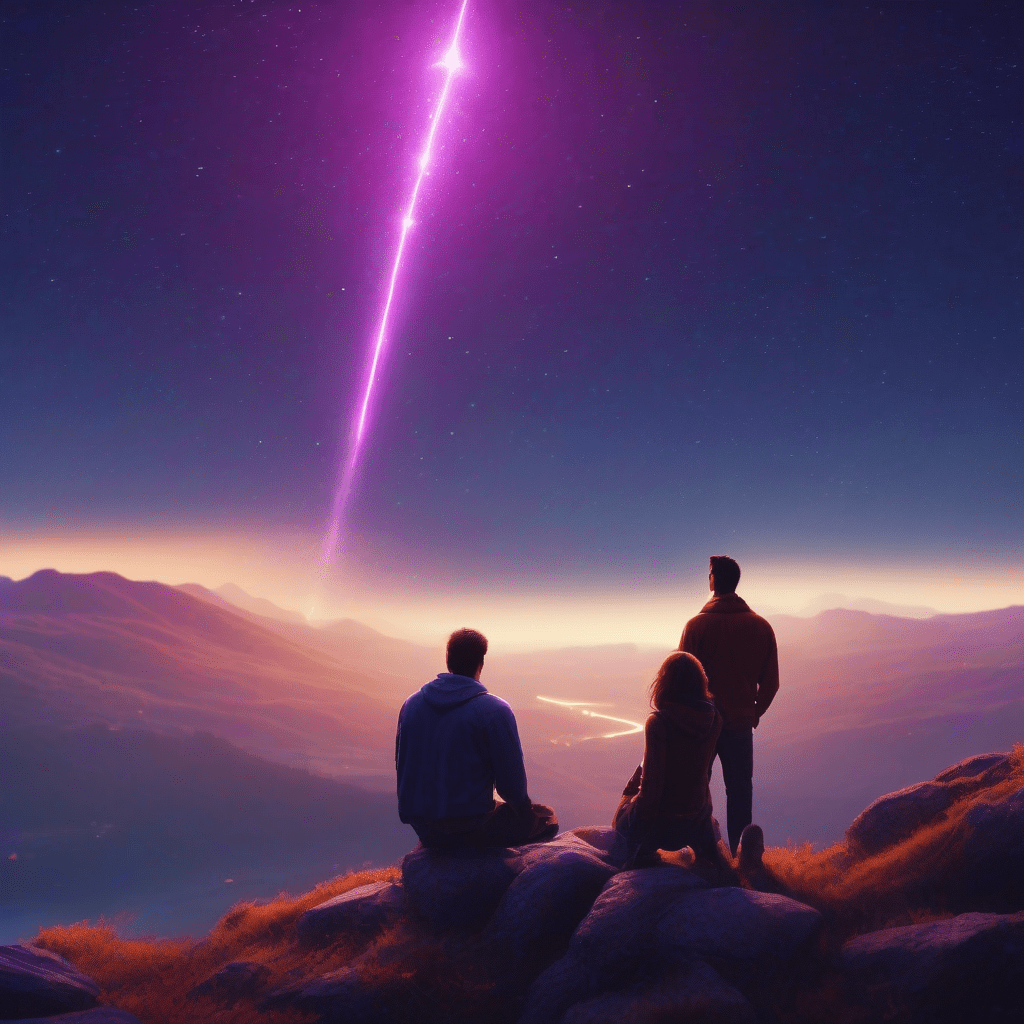
The universe operates on a rhythm deeper than the ticking of any clock, a pulse that beats in the spaces between heartbeats. For Elias Thorne, a man who spent his life studying the rigid mechanics of celestial navigation, the concept of Starlit Serendipity was nothing more than a poetic abstraction—until the night he found himself standing on a cliffside in Cornwall, watching a meteor shower that shouldn’t have been there. It was in that moment, under a sky ignited by phantom light, that he understood how destiny weaves its threads. Life is not merely a sequence of logical progressions; it is a tapestry of uncalculated accidents and profound mysteries, where a single glance can alter the trajectory of a soul forever. This story is an exploration of that cosmic alignment, a narrative of how the intangible forces of the universe guide us toward our true purpose.
The Observatory of Lost Dreams
Elias lived within the confines of his grandfather’s observatory, a stone tower perched precariously on the edge of the Atlantic. The air inside always tasted of ozone and ancient dust, and the walls were lined with leather-bound volumes concerning astrology and the history of the stars. He believed that if he could just map the sky with enough precision, he could find the answer to the loneliness that sat in his chest like a lead weight. Every night, he tracked the movement of the planets, his fingers tracing the cold brass of the telescope, whispering questions to a silent firmament.
The Arrival of the Unexpected
One Tuesday, while the fog rolled in like a slow-moving tide, a knock resonated against the heavy oak door of the tower. Standing there was Clara, a woman who carried with her the scent of rain-drenched jasmine and the chaotic energy of a thunderstorm. She claimed to be a cartographer of forgotten places, someone who mapped the geography of human emotion rather than physical land. Her arrival disrupted the orderly entropy of Elias’s life, forcing him to look away from his lens and toward the living, breathing reality of a person standing before him. The atmosphere in the room shifted, crackling with an energy that felt like Starlit Serendipity manifested in the flesh.
The Shared Map of Silence
They spent days in the library, not speaking of stars, but of the maps they had drawn for themselves—maps that had failed them. Clara spoke of her travels through cities that didn’t appear in atlases, places where time seemed to fold in on itself. Elias found himself captivated by the way she described a sunset in a remote alpine tundra, painting the scene with words that made him feel the biting chill and the overwhelming warmth of the horizon. Their conversations became a dance of intellect and vulnerability, a slow shedding of the masks they had worn to shield themselves from the world.
The Geometry of Love
As the weeks bled into months, the observatory began to feel less like a prison and more like a sanctuary. Elias realized that the patterns he had been seeking in the stars were actually mirrored in the way Clara tilted her head when she was thinking, or the way she traced the constellations on the floorboards with her fingertips. Starlit Serendipity was not a one-time event; it was the persistent, quiet affirmation that two people were moving along the same celestial path, destined to collide at the perfect interval of light and shadow.
Whispers of the Celestial Plane
Clara taught Elias to see the geometry of love in the mundane. She showed him how the way the moonlight hit the waves was an equation of longing, and how the silence between them was a harmonic resonance of two souls finding equilibrium. They were no longer studying the universe from afar; they were participating in its grand design. The fear that had anchored Elias to his tower began to dissolve, replaced by a reckless, beautiful hope that life could be more than just observation.
The Fracture in the Foundation
But the world outside the observatory was not as kind as the internal universe they had built. News from the mainland spoke of instability, of encroaching shadows, and of the necessity for Elias to return to his duties in the capital. The separation felt like a cosmic rupture. They spent their final night together on the gallery of the tower, the stars watching with a cold, indifferent beauty as the reality of their potential divergence settled over them like a shroud. How could two people, so deeply integrated, survive the cruelty of distance?
The Promise of the Infinite
“If the stars can hold their positions for eons,” Clara whispered, her hand locked in his, “then surely we can hold this space for one another.” It was a vow that defied logic and embraced the inexplicable nature of Starlit Serendipity. They did not promise to be together in the physical sense, but to be tethered to one another in the metaphysical. This connection was an anchor in a world that insisted on drifting. They understood that even if their paths crossed only once every few years, the resonance of this shared time would echo through their existences, providing gravity to their scattered thoughts.
The Legacy of the Light
Years passed, and though they lived in different corners of the globe, the bond remained as taut as a violin string. Elias returned to his maps, but he no longer sought escape; he sought connection. Clara continued her mapping of the world, leaving behind small notes in libraries and archives that were meant only for him to find. They had become a living embodiment of Starlit Serendipity, proving that love is not just a presence, but an enduring frequency that survives the vacuum of absence.
FAQ
What is the core meaning of Starlit Serendipity?
Starlit Serendipity represents the belief that our most meaningful connections are guided by forces beyond our control, much like the alignment of stars. It suggests that chance encounters are actually manifestations of cosmic design.
How does the setting influence the development of the characters?
The observatory acts as a catalyst for isolation, forcing the characters to confront their inner selves. The transition from the rigid academic environment to the shared intimacy of the space allows them to shed their societal roles.
Is this story grounded in scientific reality?
While the story uses celestial terminology as a metaphor, it is a work of fiction. It uses scientific concepts to explore the philosophical and emotional landscapes of the characters.
Why is the theme of distance so central?
Distance serves to test the authenticity of the bond. By removing the convenience of physical proximity, the story highlights that true connection transcends location and thrives on memory and spiritual alignment.
Conclusion
In the end, Elias and Clara’s story serves as a testament to the power of human connection in an expansive, often chaotic universe. By embracing Starlit Serendipity, they learned that we are never truly alone, provided we keep our eyes open to the patterns that bind us. Whether through a chance meeting on a lonely cliff or a quiet thought shared across oceans, the threads of our lives are woven into a greater narrative. This story reminds us that our greatest journeys are not those we plan, but those we stumble into, guided by the quiet, radiant light of a destiny we are meant to fulfill. We are all searching for that one resonance, and when we find it, we must cherish it as the most profound treasure of our existence.Unleash Your Inner Genius with AI Agents in 2026When two strangers became forever: A Real-Life Story of SuccessGujarati Romantic Story: Mehul and Kavya’s Heart Touching Moments of True Love